Liguria: History and Natural Charm
Among all the Italian regions we have explored so far on our blog, the region of Liguria stands out for its history. A great maritime power open to change, Liguria was once a centre of economic, social, and technological power in Italy. Many of its major cities, such as Genoa, Savona, and Imperia, hide fascinating curiosities for visitors, alongside their beautiful and enigmatic landscapes kissed by the sea and close proximity to France. In today’s article, we’ll travel to Liguria to reveal some curiosities about the region and its cultural heritage. Ready?
The Cinque Terre
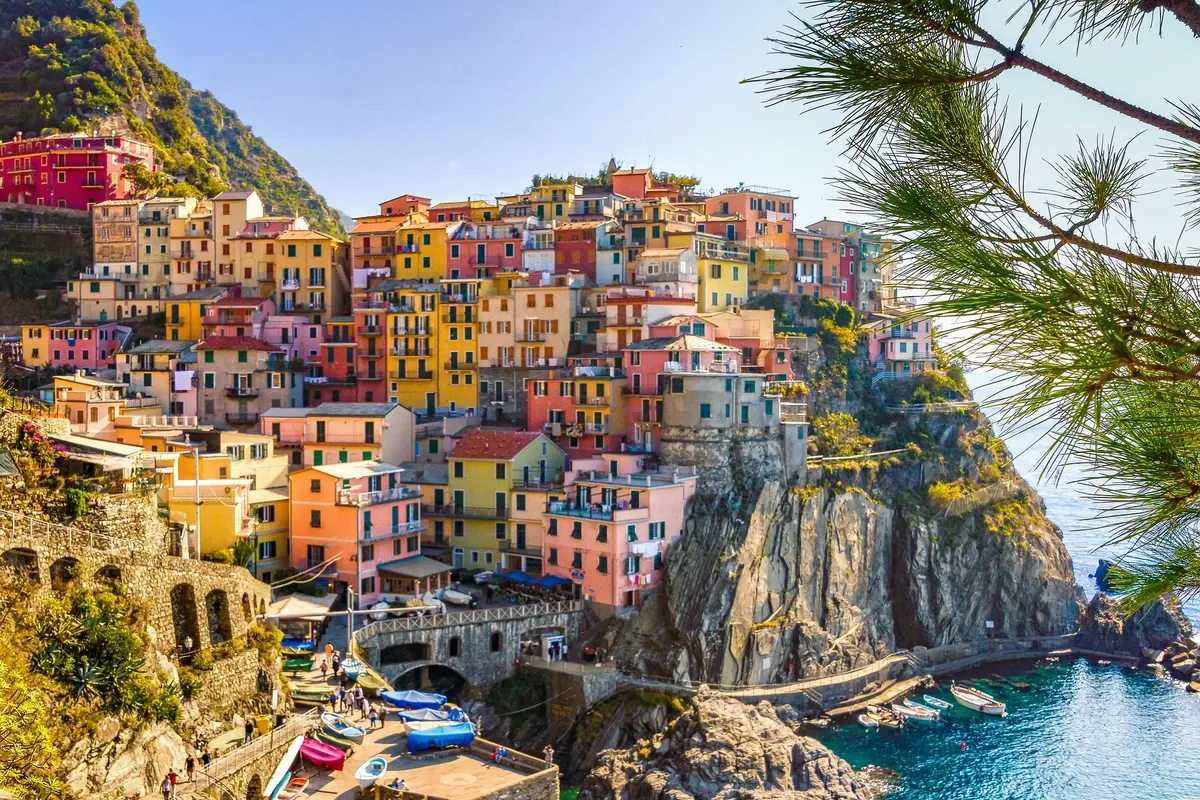
Along the Italian Riviera, you can find a northern line of five coastal towns (Corniglia, Manarola, Monterosso al Mare, Riomaggiore, and Vernazza) with a unique natural heritage that harmoniously combines mountain heights with sea cliffs, offering an enchanting and passionate composition of urban and natural elements.
Although originally these five towns remained unnoticed for many years, today they are a popular tourist attraction, drawing increasing numbers of visitors annually thanks to the quality of their landscapes and especially the opportunity to take special itineraries along the coastline via various trails. Along the way, you’ll encounter picturesque houses, forts and castles, natural harbours, museums, churches, vineyards, olive groves, and much more….
The Home of Pesto
Pesto is a well-known Italian sauce found in most Italian restaurants and trattorias. It is one of the culinary symbols of the region par excellence, which has contributed significantly to Italian cuisine. Pesto is a Genoese word that translates to “crush or grind,” and it is featured in most prestigious Italian cookbooks, such as the famous «La Vera Cuciniera Genovese Facile ed Economica» by Emanuele Rossi, published in 1865.
This condiment is made from seven ingredients that are first ground and then finely chopped. The resulting mixture consists of basil, Genoese basil, pine nuts, garlic, Parmesan cheese and/or sheep’s cheese, olive oil, and coarse sea salt.
Some Ligurian dishes you must try:
- Focaccia
- Bacalao "alla badalucchese"
- Pansoti
- Farinata
- Cima alla genovese
- Torta Pasqualina
The Largest Aquarium in the World
Opened in 1992, the Genoa Aquarium is Italy’s largest maritime complex and the second-largest aquarium in Europe. With its 70 tanks and a collection of over 600 different species, the structure reproduces marine ecosystems of exceptional biological importance. A visual spectacle where you can discover fish of all kinds, sizes, and colours from the Red Sea, the Mediterranean, and the Pacific Ocean.
Whale Watching
Do you love whales? Not far from the aquarium and in the heart of Liguria’s coastline, you can spot these cetaceans in the wild—a tourist attraction that usually requires travelling hundreds or thousands of kilometres. It’s a spectacle that’s definitely worth it!
Following the Footsteps of Christopher Columbus
The origins of Christopher Columbus, globally known for discovering America in 1492, have been a subject of debate for years. Many experts attributed his roots to Portugal, Spain, Italy, and other European locations. After recent research, the most accepted theory is that Christopher Columbus was actually Genoese, particularly due to evidence found in a small town in Genoa where the explorer spent his childhood, as well as the Italian roots of his relatives.
The reason for his obscure origins, which have given historians quite a headache, is mainly because Columbus himself decided to hide them for his safety. In addition to his Jewish heritage (the Catholic Monarchs expelled Jews from Spain), he maintained some enmities with other noble houses.
Christ in the Abyss
This is perhaps one of Liguria’s most hidden curiosities. Near the Cinque Terre, there is a statue of Christ at the bottom of the sea, remarkably well-preserved. Believe it or not, it’s not a relic from a sunken city or the remains of a treasure from a shipwreck. It is a sculpture intentionally placed at the bottom of the sea in 1950 as a tribute to Dario Gonzatti, the first Italian to use scuba diving equipment, and to all those who lost their lives diving.
Want to discover more secrets and curiosities of Italy? Click here!
